5 most common mistakes when preparing for the CPC exam.
Sarah J.
2/27/20263 min read
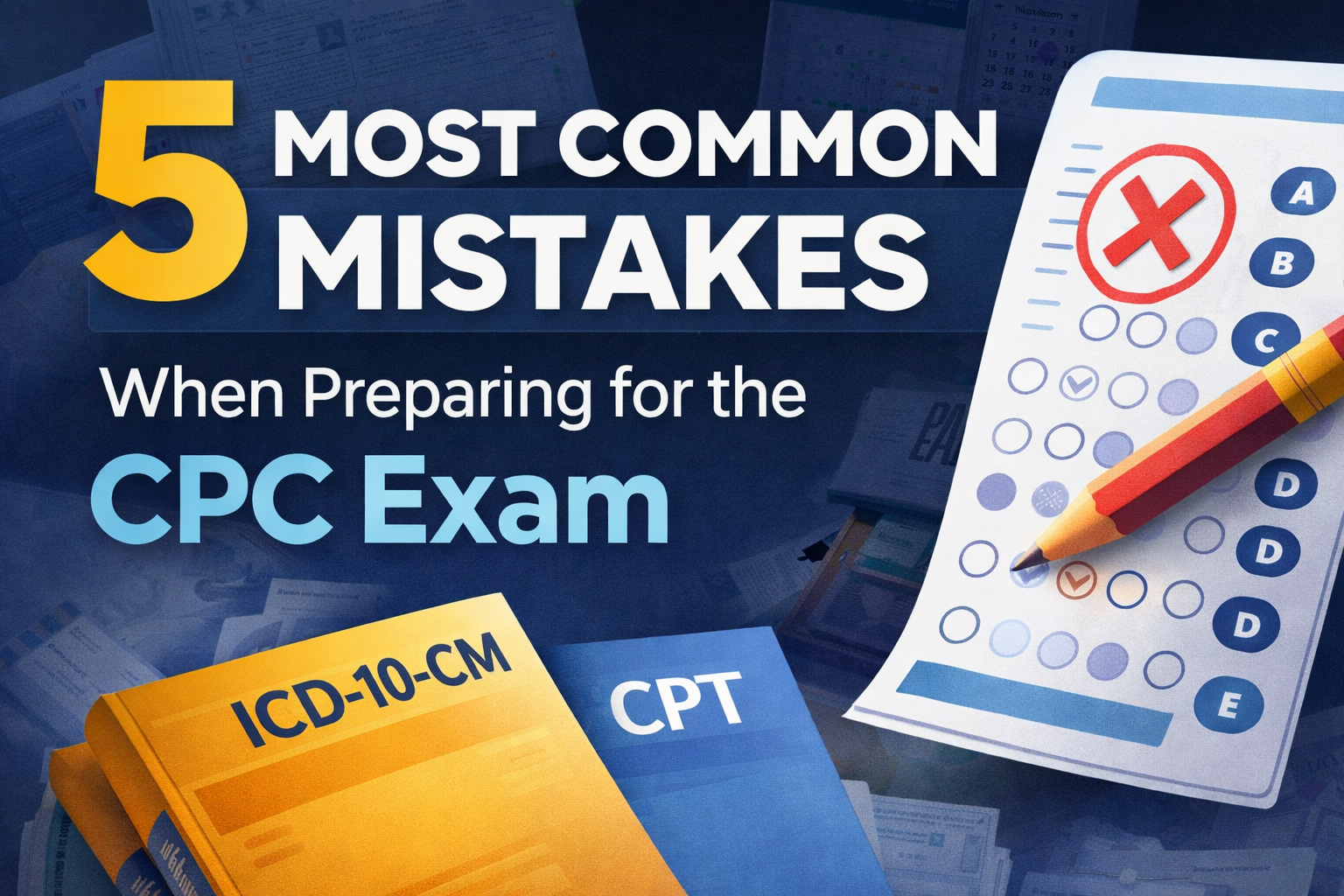
Understanding the 5 Most Common Mistakes When Preparing for the CPC Exam
Preparing for the CPC (Certified Professional Coder) exam can feel overwhelming—even for highly motivated learners. With a wide range of coding guidelines, time pressure, and complex medical scenarios, it’s easy to fall into common traps that slow your progress or hurt your exam performance.
The good news? Most CPC candidates struggle with the same mistakes—and once you understand them, you can avoid them entirely.
Below are the five most common mistakes and how to fix them so you can prepare smarter, not harder.
1. Memorizing Codes Instead of Understanding Concepts
One of the biggest mistakes candidates make is trying to memorize ICD-10-CM, CPT, or HCPCS codes instead of learning how to navigate and interpret them.
Why this is a problem:
The CPC exam is open book
Questions test your ability to apply guidelines, not recall codes from memory
Memorization leads to confusion when questions are slightly altered
What to do instead:
Focus on:
Understanding code structure
Learning guidelines and conventions
Practicing how to locate codes quickly
Real-world example:
Instead of memorizing a diabetes code, understand:
How to identify type
How complications are coded
Where to find it in the index and tabular
👉 This approach works across all scenarios, not just one.
2. Ignoring Official Guidelines
Many candidates rely too heavily on practice questions or shortcuts and skip deep study of official coding guidelines.
Why this is a problem:
The CPC exam is guideline-driven
Many questions are designed to test specific rules
Without guideline knowledge, answers feel like guesses
What to do instead:
Study ICD-10-CM guidelines regularly
Pay attention to:
Sequencing rules
“Code first” and “Use additional code” notes
Excludes1 vs Excludes2
Real-world example:
A question may look straightforward—but if you miss a sequencing rule, the entire answer is wrong.
👉 Guidelines are often the difference between two very similar answer choices.
3. Not Practicing Under Timed Conditions
Many candidates feel confident during practice—but struggle on exam day due to time pressure.
Why this is a problem:
The CPC exam is timed (100 questions / ~4 hours)
You have about 2.4 minutes per question
Without timing practice, pacing becomes a major issue
What to do instead:
Take full-length timed mock exams
Practice:
Skipping difficult questions
Returning later
Maintaining steady pacing
Real-world example:
A candidate who knows the material but spends too long on early questions may run out of time before finishing.
👉 Time management is just as important as knowledge.
4. Overlooking Documentation Details
Another major mistake is not carefully analyzing the medical documentation provided in questions.
Why this is a problem:
CPC questions are based on real-world scenarios
Small details can change:
Code selection
Modifiers
Sequencing
What to do instead:
Train yourself to:
Identify key terms (diagnosis, procedures, laterality, complications)
Look for:
Specificity (acute vs chronic)
Location
Associated conditions
Real-world example:
Missing a word like “bilateral” or “with complications” can lead to the wrong answer—even if everything else looks correct.
👉 Coding accuracy depends on details, not assumptions.
5. Skipping Weak Areas Instead of Fixing Them
It’s natural to focus on what you’re good at—but avoiding weak areas is one of the fastest ways to fail the exam.
Why this is a problem:
The CPC exam covers multiple domains
Weak areas (like E/M, modifiers, or guidelines) can cost you multiple questions
Repeated mistakes compound quickly
What to do instead:
Identify weak areas early
Use targeted practice (like coding sprints or flashcards)
Revisit those topics until they become strengths
Real-world example:
If you consistently miss modifier questions but ignore them, you may lose 5–10 questions on exam day.
👉 Fixing weak areas gives you the highest return on effort.
Final Thoughts
Success on the CPC exam isn’t about studying more—it’s about studying correctly.
By avoiding these five common mistakes, you can:
Improve accuracy
Increase confidence
Manage your time effectively
Walk into the exam fully prepared
Remember, the CPC exam is designed to test how you think—not just what you know.
Take the Next Step
The best way to overcome these mistakes is through structured, real-world practice.
Use tools that simulate:
Timed exam conditions
Real coding scenarios
Immediate feedback on weak areas
👉 Start practicing smarter—and turn these common mistakes into your biggest advantages.
CPC Exam Ready
Practice exams, coding sprints, and study tools designed to help medical coding students prepare for the CPC certification exam with confidence.
Contact us @
Subscribe to our blog
info@cpcexamready.org
© 2026. All rights reserved.